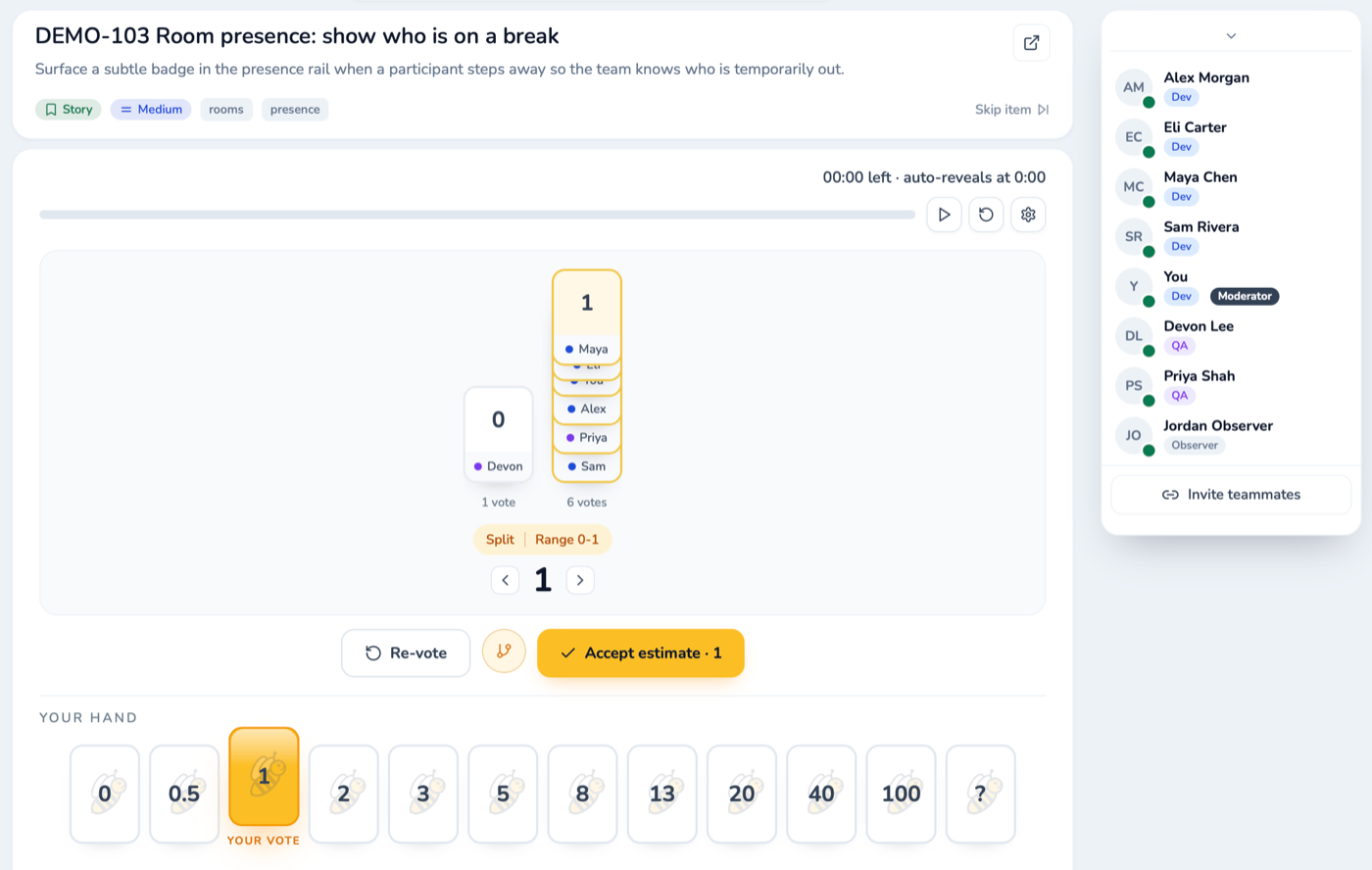
Three picks cover most teams. SprintBee — our product, disclosed below — for distributed teams that want async estimation and Jira or Linear write-back without per-user pricing. Parabol if you want retrospectives and estimation in one open-source platform. Pointing Poker if you just need a free, no-signup room right now. Here is how all nine compare, as of July 2026.
Every tool in this roundup does the basics: teammates pick a card in private, everyone reveals at once, and the spread starts a conversation. The differences that actually matter show up around the edges, so we compared each tool on five criteria: whether hidden voting is done well (simultaneous reveal, no peeking, something that surfaces disagreement), whether estimation can happen asynchronously or only in a live call, how deep the integrations go (importing issues is common; writing the agreed estimate back to your tracker is rarer), how honest the free tier is about its limits, and whether the pricing model fits how teams actually scale.
One disclosure before anything else: SprintBee is our product. This article lives on sprintbee.net, SprintBee is listed first, and you should read that entry knowing who wrote it. The other eight tools are ranked on merit, based on public information — official pricing pages, documentation, and independent reviews — gathered in July 2026. Where a vendor's claim could not be verified, we left it out. Pricing changes often, so treat every figure here as a snapshot and check the vendor's page before you buy.
One tool you may see in older roundups is missing here: Chpokify. As of July 2026 its domain serves only a parking page and the product appears to be offline, so we removed it from consideration.
SprintBee is our web-based planning poker app, built to keep estimation fast whether your team meets or not. Live sessions get hidden voting with simultaneous reveal, divergence highlighting so the widest disagreements are obvious at a glance, in-room item splitting — break a too-big work item into new items that inherit its context — and end-of-session scorecards covering vote alignment and how each item got resolved. The headline differentiator is async: voting windows let you queue items and give teammates a day or two to vote privately on their own schedule, items where the votes agree settle automatically, and the team only meets to discuss the items that split.
The free plan includes one active Workspace with a Planning Room and Retro Room. The Planning Room supports unlimited teammates, async estimation, custom decks, and completed-item history with CSV export; participants join by link with no account, and sign-in for the Workspace owner is passwordless. The paid Pro plan is priced per Workspace — $9 a month or $90 a year each, with no minimum — and every Pro Workspace gets Jira and Linear integrations with story-point write-back, Slack and Microsoft Teams notifications, room security controls, and historical trends. The Browser Companion Chrome extension pairs a Jira browser tab with a Planning Room without needing Jira API access, and it works on the free tier. Caveats: SprintBee launched in 2026, so it has a shorter track record than most tools here, and there is no Azure DevOps, GitHub, or Trello import yet.
Best for
teams that estimate every sprint — live, async, or both — and want write-back and flat pricing that does not grow with head count
Pricing (August 2026)
free plan with one active Workspace and unlimited teammates, no credit card; Pro $9 per Workspace per month or $90 per Workspace per year — priced per Workspace, not per user, with no minimum and a 14-day free trial
Standout
async voting windows where agreeing items settle automatically, so the team only meets for the items that split
Watch out for
newer product (launched 2026); integrations are Jira and Linear only; responsive web only, no native mobile apps
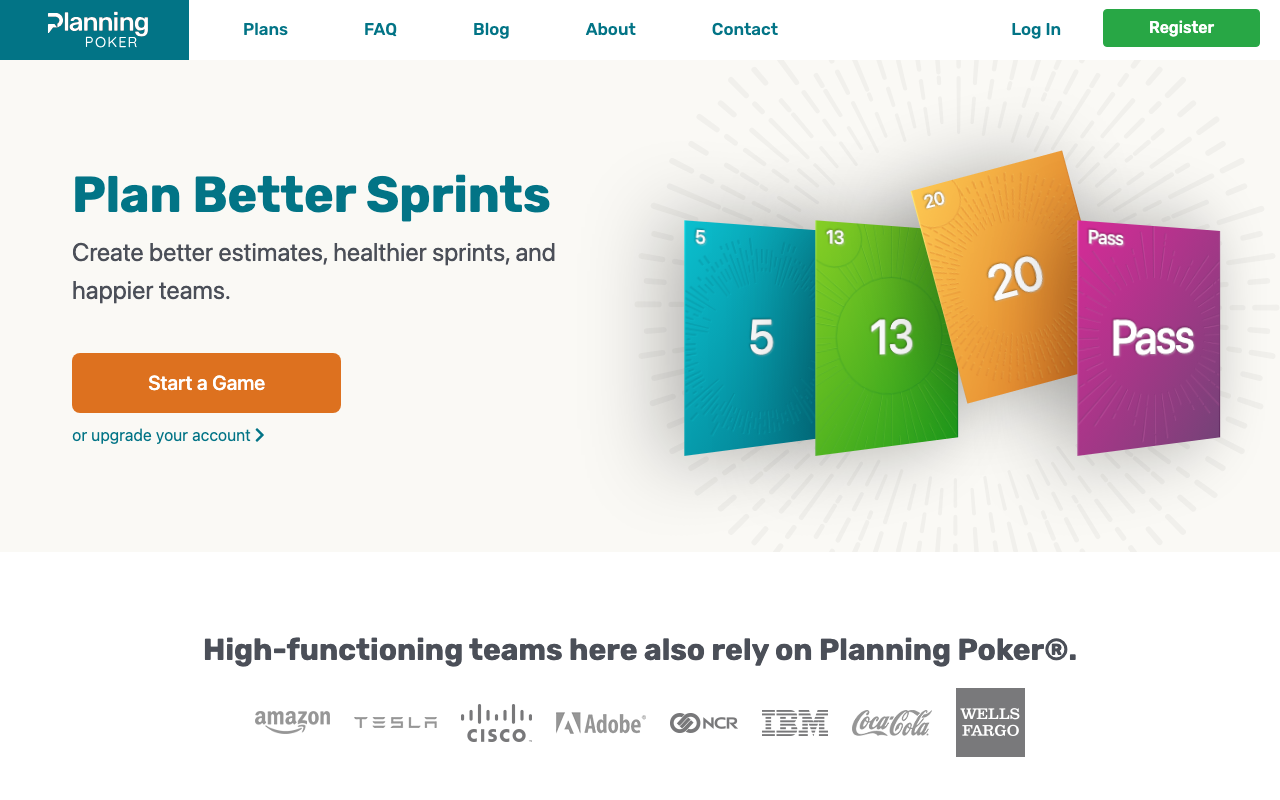
PlanningPoker.com is the tool that owns the trademark. It began with Mountain Goat Software — Mike Cohn's company — and has been operated since 2014 by the agency 352 Inc. Its model is distinctive: the game organizer pays, and players always join free without accounts, which makes it economical when one facilitator runs sessions for a large audience. The Jira integration is genuinely two-way — import stories, then sync accepted points back automatically — and the Enterprise option adds procurement affordances (purchase orders, annual invoicing, resellers) that are rare in this category.
The trade-offs are a real-time-only workflow with no async mode, and a tight free tier: five players, ads, and nearly every differentiating feature — Jira, custom decks, story details, CSV export, velocity tracking — behind the paywall. Jira setup also requires a Jira administrator to create an application link, which their own docs describe as a roughly ten-step process. Choose PlanningPoker.com if you want the established brand, per-organizer economics for big groups, or enterprise purchasing paperwork; it is the better fit than SprintBee for those cases.
Best for
one paying facilitator running sessions for large audiences, and enterprises that need POs and reseller purchasing
Pricing (July 2026)
free Basic up to 5 players, ad-supported; Standard $14.95/mo or $12.50/mo billed annually (10 participants); Pro $49.95/mo or $41.50/mo annually (50 participants); Enterprise custom — all priced per game organizer
Standout
two-way Jira sync plus the original Planning Poker brand and lineage
Watch out for
no async estimation; the free tier paywalls almost everything; Jira setup requires admin involvement
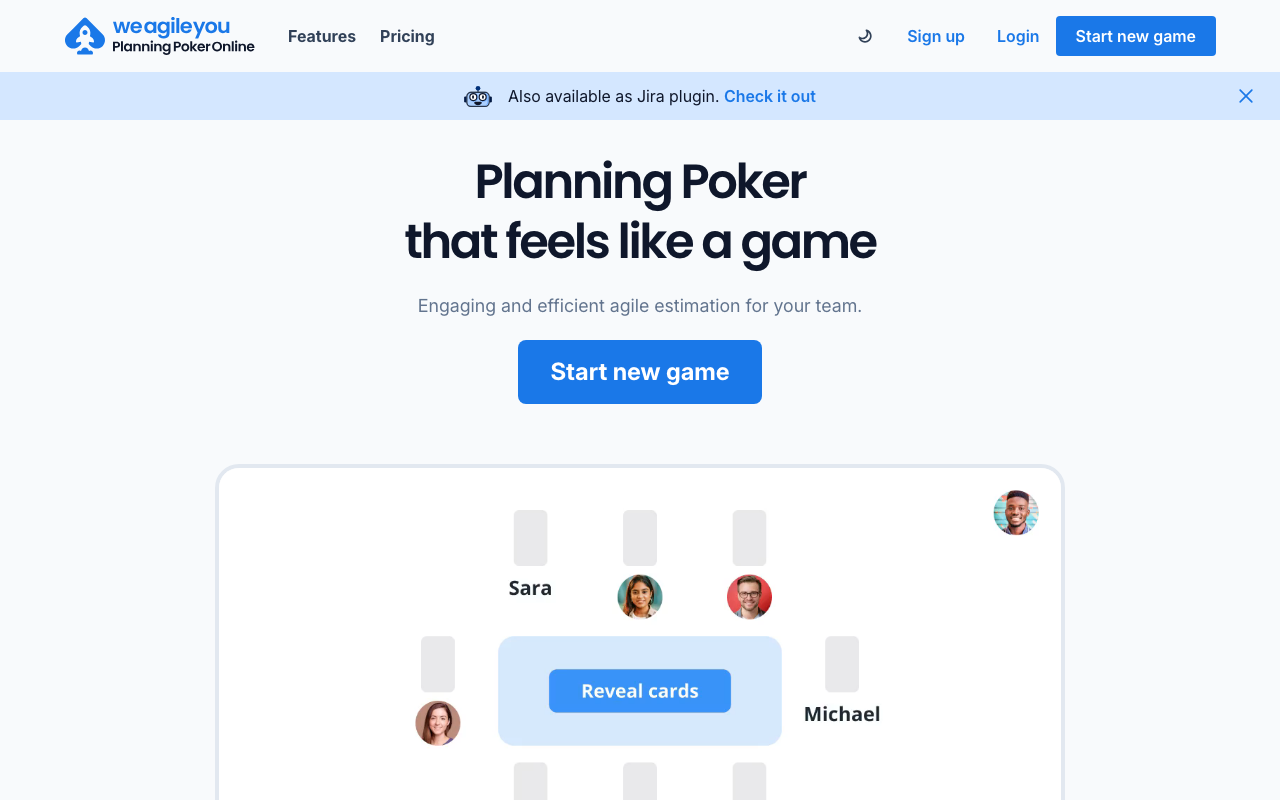
Planning Poker Online pairs a polished visual poker-table interface with the deepest Jira Cloud integration of any dedicated poker tool we looked at. Through its Atlassian Marketplace plugin you can import issues by sprint, epic, or JQL query, see full issue details in-session, and have story points written back automatically — including to custom estimation fields. Unlimited players join free on every tier, only facilitators pay, and the company leans on enterprise trust signals such as ISO 27001 certification and GDPR compliance. The official site says it supports both synchronous and asynchronous estimation, though the async mechanics are lightly documented.
The free tier is workable for trying it out but restrictive for real sprints: nine votings and five issues per game. Per-facilitator pricing at $30 a month also adds up in organizations with several scrum masters, and there is no Jira Server or Data Center support — those teams are pointed at CSV export. Choose Planning Poker Online if you run Jira Cloud, want sprint-level import with field-mapped write-back, and have one or two facilitators; that combination is its home turf.
Best for
Jira Cloud teams that want sprint/epic/JQL import and story-point write-back with custom field mapping
Pricing (July 2026)
free Basic capped at 9 votings and 5 issues per game; Premium $30 per facilitator/mo or $300 per facilitator/yr; enterprise quotes on request
Standout
the Jira Cloud plugin, plus ISO 27001 certification — unusual in this category
Watch out for
tight free-tier caps; per-facilitator costs scale with your number of scrum masters; no Jira Server/Data Center support; async mode exists but is thinly documented
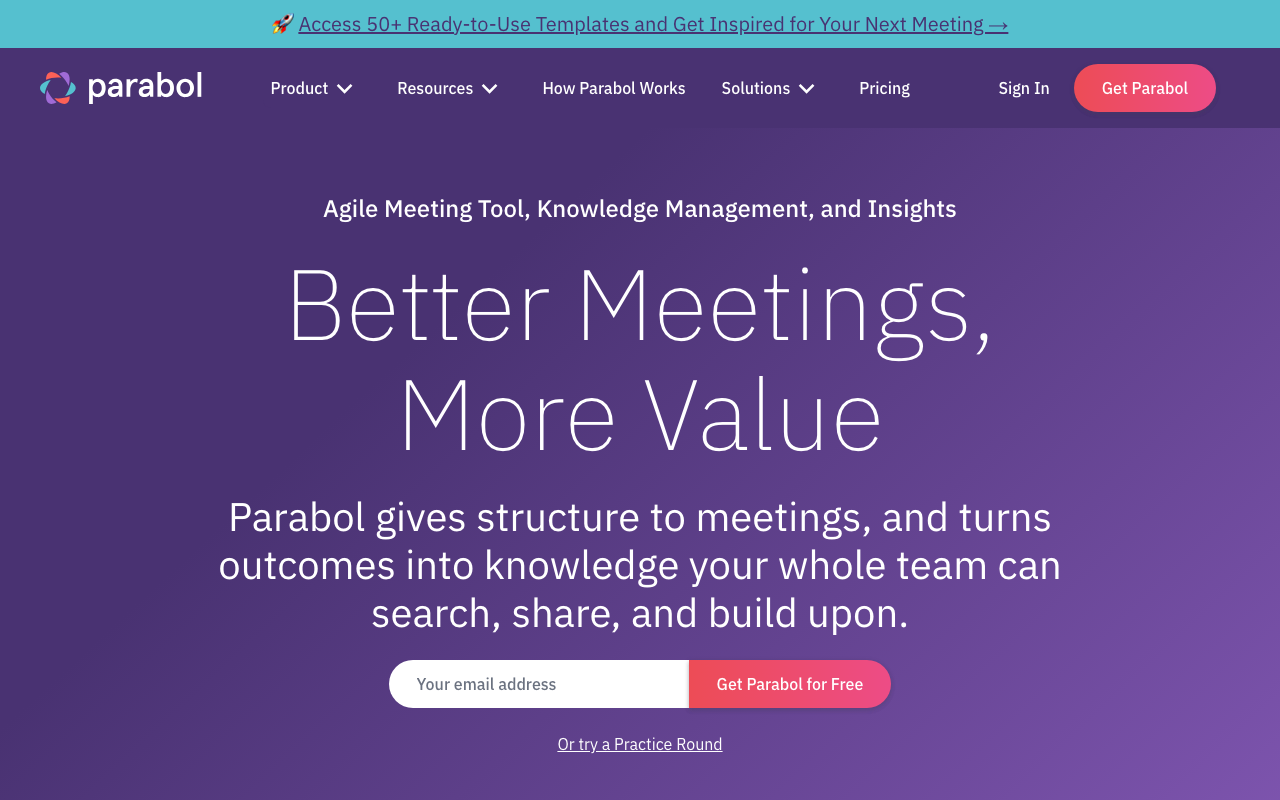
Parabol is not a poker widget; it is a full open-source agile meetings platform (AGPL v3) where Sprint Poker sits alongside retrospectives, standups, and team health checks. Its integration set is the broadest here: two-way estimate sync with Jira, GitHub, GitLab, and Azure DevOps, plus Slack and Microsoft Teams notifications. Voting is anonymous until reveal, decks include Question and Pass cards, and custom multi-dimension scales support formats like WSJF. Async works as a real workflow — open voting for a period, discuss in per-story threads, catch up from automated summaries — and billing only counts active users.
The costs of that breadth: per-user pricing gets expensive at scale (one independent review calculates a 25-person team at roughly $200 a month), the free tier caps you at two teams and ten meetings a month across the whole company, and the interface carries the weight of a full meeting suite. Choose Parabol if you want estimation and retrospectives in one tool, if you need Azure DevOps or GitHub estimate sync, or if open source and self-hosting matter to you — for all three of those cases it is a stronger fit than SprintBee.
Best for
teams that want retros, standups, and estimation in one open-source platform, or need Azure DevOps/GitHub/GitLab sync
Pricing (July 2026)
free Starter with unlimited users but 2 teams and 10 meetings/mo; Team $8 per active user/mo; Enterprise custom with SAML SSO and SCIM
Standout
two-way estimate sync across Jira, GitHub, GitLab, and Azure DevOps — the broadest first-party set in this roundup
Watch out for
per-user pricing at scale; a fuller, heavier product than a single-purpose poker room; self-hosting the open-source version takes real technical effort
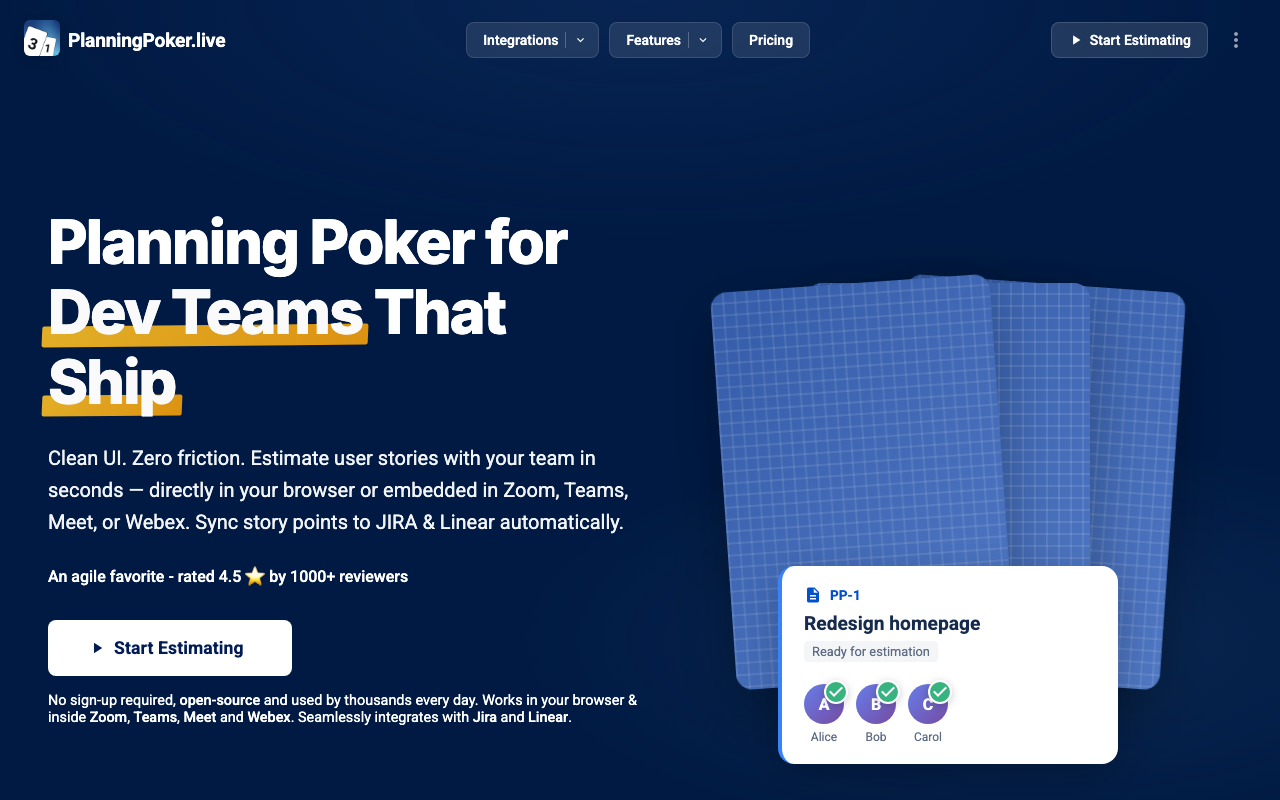
PlanningPoker.live is an open-source, indie-built tool with an unusual angle: it runs as an embedded app inside Zoom, Microsoft Teams, Google Meet, and Webex, so the cards live in the same window as the call. Joining and voting are always free with no account, and — rare among free tools — two-way Jira and Linear sync, async voting, custom decks, and an AI session-summary bot are all available on the free tier. Instead of a subscription, creating rooms consumes credits: you get some free, then buy one-time bundles.
That credit model is the main thing to understand before adopting it. Occasional teams do well — $9 covers seven rooms, and credits from paid bundles never expire — but a facilitator creating rooms every sprint needs to keep topping up or reuse rooms. The free tier carries ads, free starter credits expire after two months, and there is no Azure DevOps or GitHub integration. Choose PlanningPoker.live if your team estimates during video calls and wants the cards embedded in the meeting itself, or if you estimate rarely enough that a one-time $9 bundle beats any subscription.
Best for
teams that estimate inside Zoom, Teams, Meet, or Webex, and occasional estimators who prefer one-time payments to subscriptions
Pricing (July 2026)
joining and voting always free; room creation costs credits — 5 free at signup plus free monthly credits, then one-time ad-free bundles at $9 (7 credits), $17 (15), or $50 (50)
Standout
native embedded apps for all four major meeting platforms, with two-way Jira and Linear sync on the free tier
Watch out for
ads on the free tier and starter credits that expire after two months; no Azure DevOps or GitHub integration; async voting is advertised but lightly documented
Three tools compete on the same promise: a room in seconds, no signup, no ceremony.
Choose any of these when the whole requirement is "cards, reveal, done" — a guest-heavy session, a one-off exercise, or a team that keeps estimates in its tracker manually anyway. If you later want history, exports, or write-back, you will be shopping again; SprintBee's free plan or PlanningPoker.live are the natural next steps.
Pointing Poker
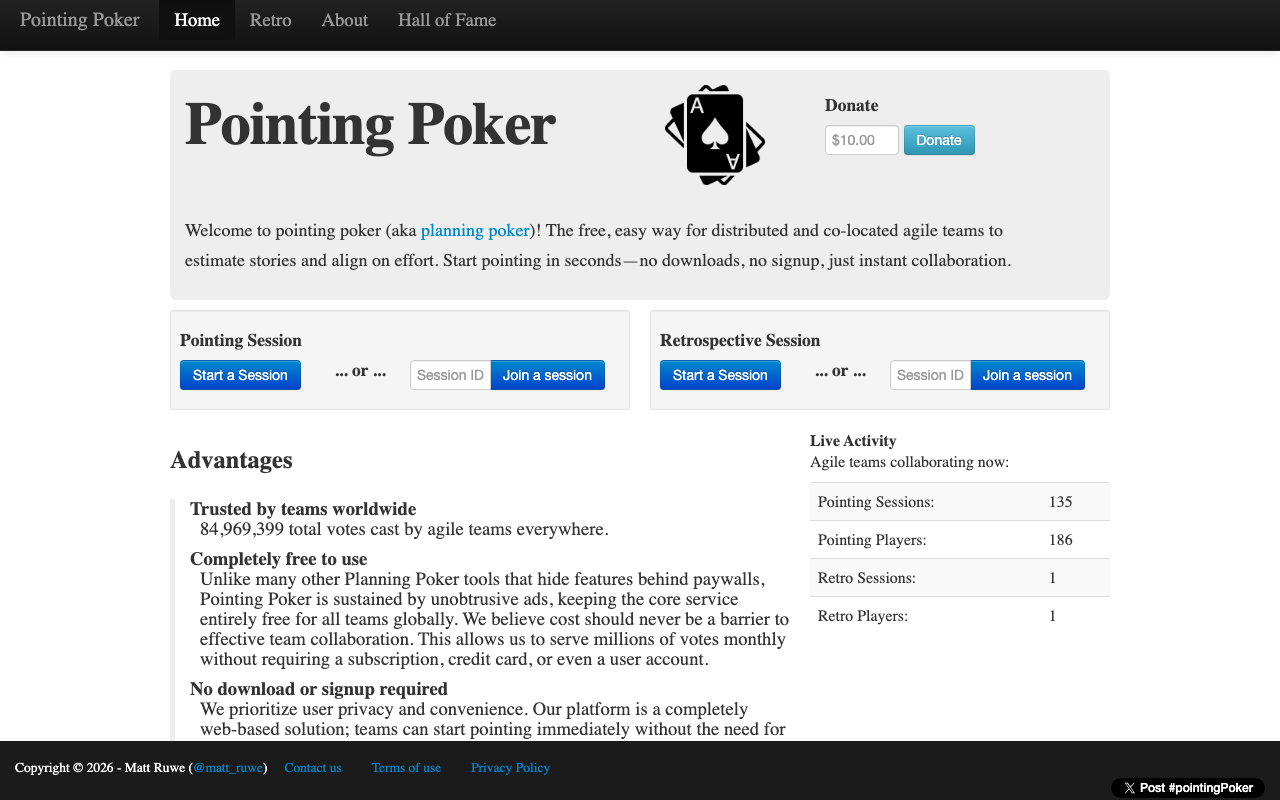
Pointing Poker is the purest version of the no-ceremony room — entirely free, ad-supported, with no accounts and no paid tier at all. It has four preset decks, player and observer roles, and useful per-session statistics, and it deliberately keeps no data: sessions auto-delete when everyone leaves. That is a genuine privacy feature and a genuine limitation — there is no history, no export, and no integrations, and any participant can reveal or clear votes mid-round.
Best for
truly free, zero-signup sessions
Pricing (July 2026)
$0, ad-supported, no paid tier
Standout
radical simplicity and a no-data-retention privacy stance
Watch out for
no integrations, no history or export, real-time only, and anyone can reveal or reset votes
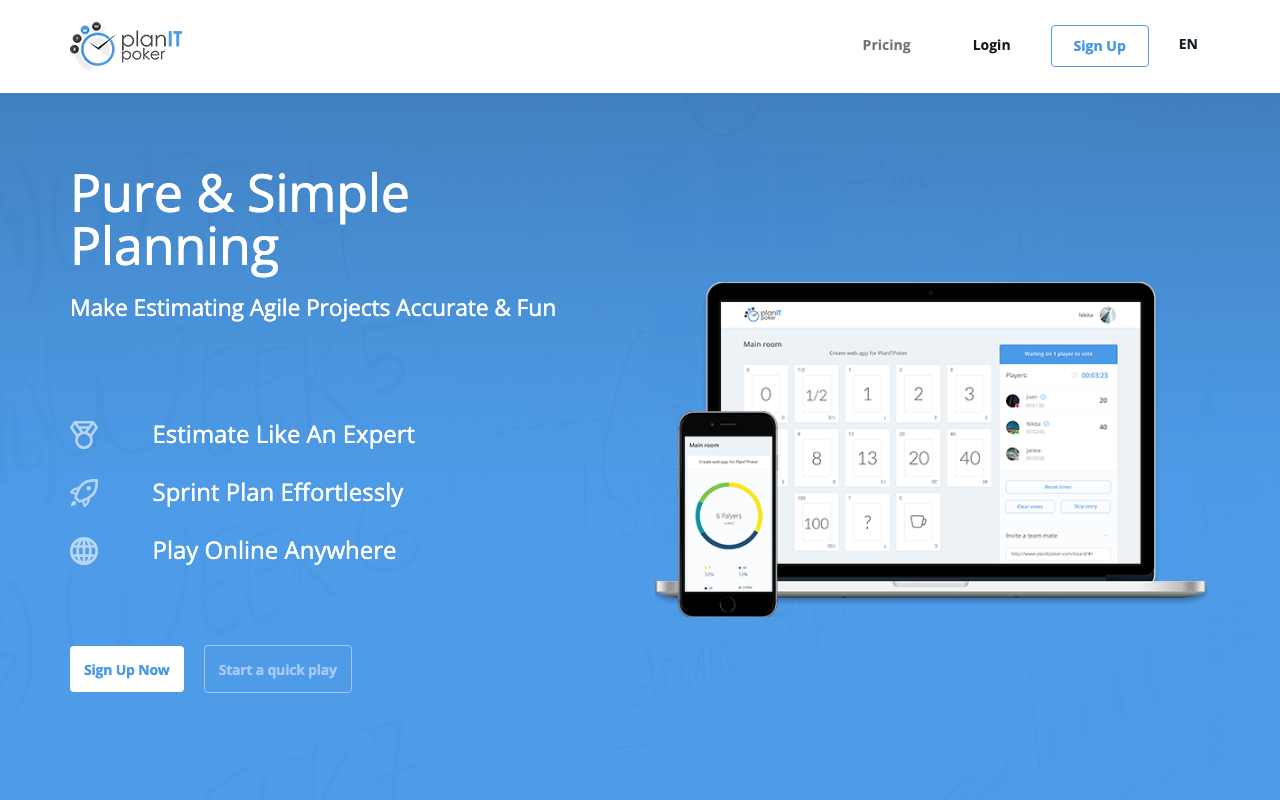
PlanITpoker adds a bit more structure: free Quick Play rooms for up to seven participants with unlimited rooms and stories, CSV/XML import, and a flat $20/mo premium that removes the participant cap. Its Jira integration imports issues but does not write estimates back, and there is no async mode.
Best for
small teams wanting free unlimited rooms with light Jira import
Pricing (July 2026)
free up to 7 participants; PlanIT Premium $20/mo flat for unlimited participants
Standout
no-signup Quick Play plus CSV/XML and Jira issue import
Watch out for
Jira import is one-way with no estimate write-back; no async mode; user reviews describe the feature set as basic, with limited analytics
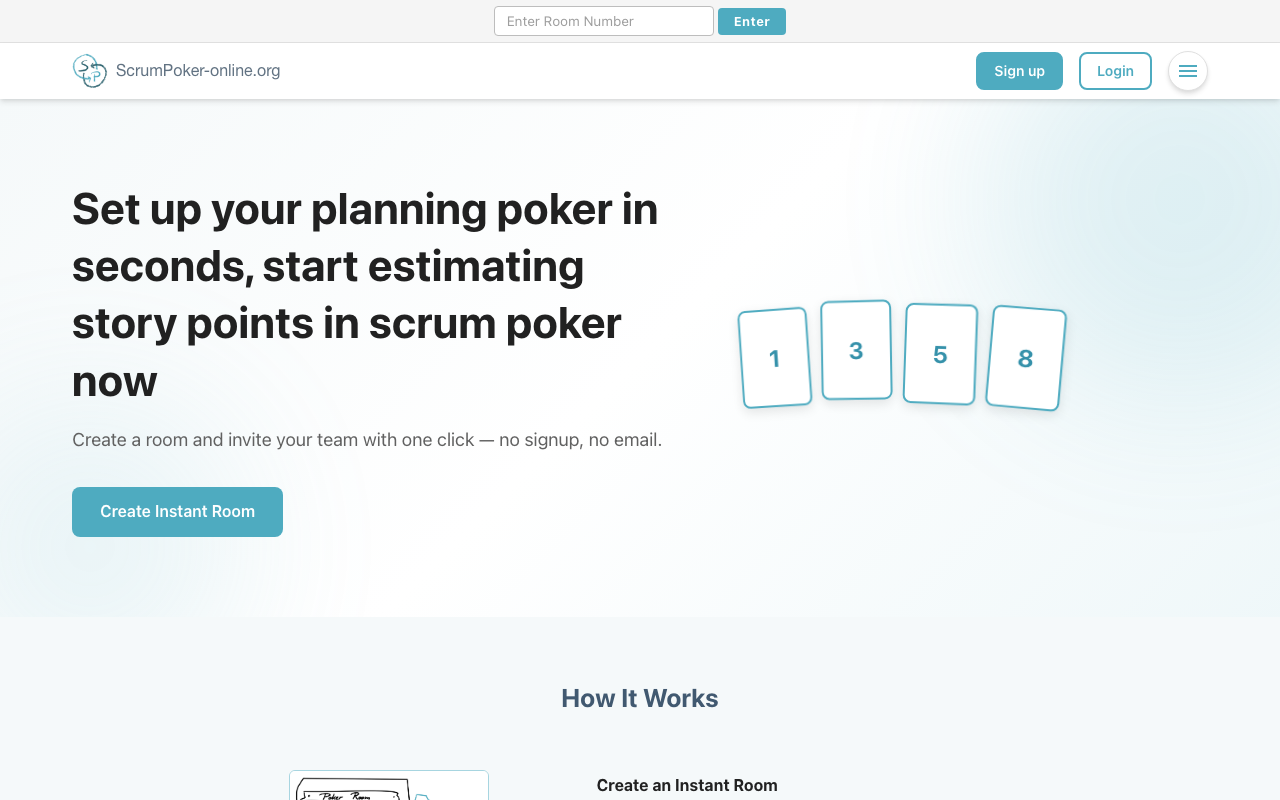
Scrum Poker Online takes the flat-pricing idea furthest: the free tier has no signup and no participant limit (with ads), and a single $40/yr premium subscription covers everyone in the owner's room, adding a timer, automatic average and median, and an attendance indicator. It has no integrations at all, by design, and no round history or export.
Best for
budget-conscious teams that want ad-free flat pricing
Pricing (July 2026)
free with no signup and no participant limit, ad-supported; Premium $40/yr flat, covering everyone in the owner's room
Standout
one cheap subscription for the whole team, in six interface languages
Watch out for
no integrations, no async, no round history or CSV export
TeamRetro comes at estimation from the retrospective side. The main product is a paid agile-meetings platform — retros, team health checks, and, since early 2026, full estimation meetings with story-by-story facilitation and anonymous voting. It imports items from Jira, Azure DevOps, GitHub, or Linear, and syncs final estimates back to Jira, GitHub, and Linear; estimate write-back to Azure DevOps is not documented. Pricing is per team with unlimited members rather than per seat, which gets economical for larger teams: US$50/mo billed annually covers three teams of any size. Alongside it, TeamRetro offers a genuinely free standalone planning poker tool at planning-poker.teamretro.com with no signup, reusable room numbers, and six decks.
Keep the two offerings straight: the free tool has no integrations, no persistent estimate storage, and no custom decks — those live in the paid product, which has no free tier at all, only a 30-day trial. Async is officially documented for retrospectives (a brainstorm-first workflow), but not for estimation, which is described as real-time. Choose TeamRetro if your team also needs health checks or if per-team pricing with unlimited members fits your size better than per-user or Workspace-count models. SprintBee now combines Planning and Retro Rooms in each Workspace, but remains focused on estimation, retros, and their follow-through rather than broader team-health surveys.
Best for
teams already using TeamRetro for retrospectives, and large teams that benefit from per-team pricing with unlimited members
Pricing (July 2026)
free standalone poker tool with no signup; main product has no free tier — 30-day trial, then Single Team US$250/yr (about US$25/mo billed monthly), Small Organization US$600/yr for 3 teams, Large Organization from US$900/yr, Enterprise custom
Standout
estimation, retros, and health checks in one platform, with paid item import from Jira, Azure DevOps, GitHub, and Linear and estimate sync back to Jira, GitHub, and Linear
Watch out for
the free tool has no integrations, storage, or custom decks; async is documented for retros but not for estimation
There is no single best planning poker app — there is a best fit for how your team works. Name your situation and pick the tool built for it.
Whatever you pick, run one real refinement session before committing. Every tool here has a free way in — a free tier, a free trial, or in SprintBee's case a public demo room — and thirty minutes with your actual backlog tells you more than any roundup, including this one.
Free forever, zero friction: Pointing Poker for pure simplicity, or Scrum Poker Online if you want ad-free for $40/yr flat. SprintBee's free plan fits if you also want async voting, history, and CSV export
Jira-heavy team: Planning Poker Online for the deepest Jira Cloud import and write-back; PlanningPoker.com if you need enterprise procurement; SprintBee if you want Jira write-back with per-Workspace pricing
Retros and poker in one platform: Parabol (open source, per active user) or TeamRetro (per team, unlimited members)
Async-first distributed team: SprintBee, whose voting windows auto-settle agreeing items; Parabol's open-voting-window workflow is the strongest alternative
Azure DevOps or GitHub sync: Parabol syncs estimates two-way with both on any tier; TeamRetro's paid product syncs estimates to GitHub and imports from Azure DevOps
Estimating inside video calls: PlanningPoker.live, embedded directly in Zoom, Teams, Meet, and Webex
One facilitator, very large audience: PlanningPoker.com, where only the organizer pays and players join free
Dead-simple no-signup session right now: Pointing Poker, PlanITpoker Quick Play, or TeamRetro's free poker tool
It depends on what free needs to include. Pointing Poker is entirely free with no signup, but keeps no history and has no integrations. SprintBee's free plan adds one active Workspace with a Planning Room and Retro Room; its Planning Room includes async voting, custom decks, CSV export, and unlimited teammates. On PlanningPoker.live, joining and voting are always free, with room creation metered by credits. As of July 2026, all three are honest free options rather than disguised trials.
Do planning poker apps work with Jira?
Most do, but the depth varies a lot. SprintBee, Planning Poker Online, PlanningPoker.com, Parabol, PlanningPoker.live, and TeamRetro's paid product can write accepted estimates back to Jira. PlanITpoker imports Jira issues but does not sync estimates back, and Pointing Poker and Scrum Poker Online have no Jira integration at all. If write-back matters, confirm it specifically — 'Jira integration' on a pricing page often means import only.
Can planning poker be done asynchronously?
Yes, with the right tool. SprintBee is built around async voting windows: teammates vote privately over a day or two, items whose votes agree settle automatically, and the team meets only for items that split. Parabol supports an open-voting-window workflow with threaded discussion, and Planning Poker Online and PlanningPoker.live both advertise async modes. Classic tools like PlanningPoker.com, Pointing Poker, and Scrum Poker Online are real-time only.
Do teammates need accounts to vote?
Usually not. Nearly every tool in this roundup lets participants join a session by shared link without creating an account — SprintBee, PlanningPoker.com, Planning Poker Online, PlanningPoker.live, Pointing Poker, PlanITpoker, Scrum Poker Online, and TeamRetro's free tool all work this way. Typically only the person hosting or paying needs an account.
How much do planning poker apps cost?
Pricing models vary more than prices. Per-facilitator: Planning Poker Online at $30/mo and PlanningPoker.com from $14.95/mo. Per active user: Parabol at $8/mo. Per Workspace: SprintBee at $9/mo per Workspace with unlimited teammates. Flat for the whole team: PlanITpoker at $20/mo, Scrum Poker Online at $40/yr. Per team: TeamRetro from US$250/yr. One-time credits: PlanningPoker.live from $9. Match the model to how your team scales before comparing headline numbers.
Estimate together
Run your next planning session for free.
Create a SprintBee room, share one link, and help your team vote, reveal, discuss, and align in minutes.